
 EN
EN


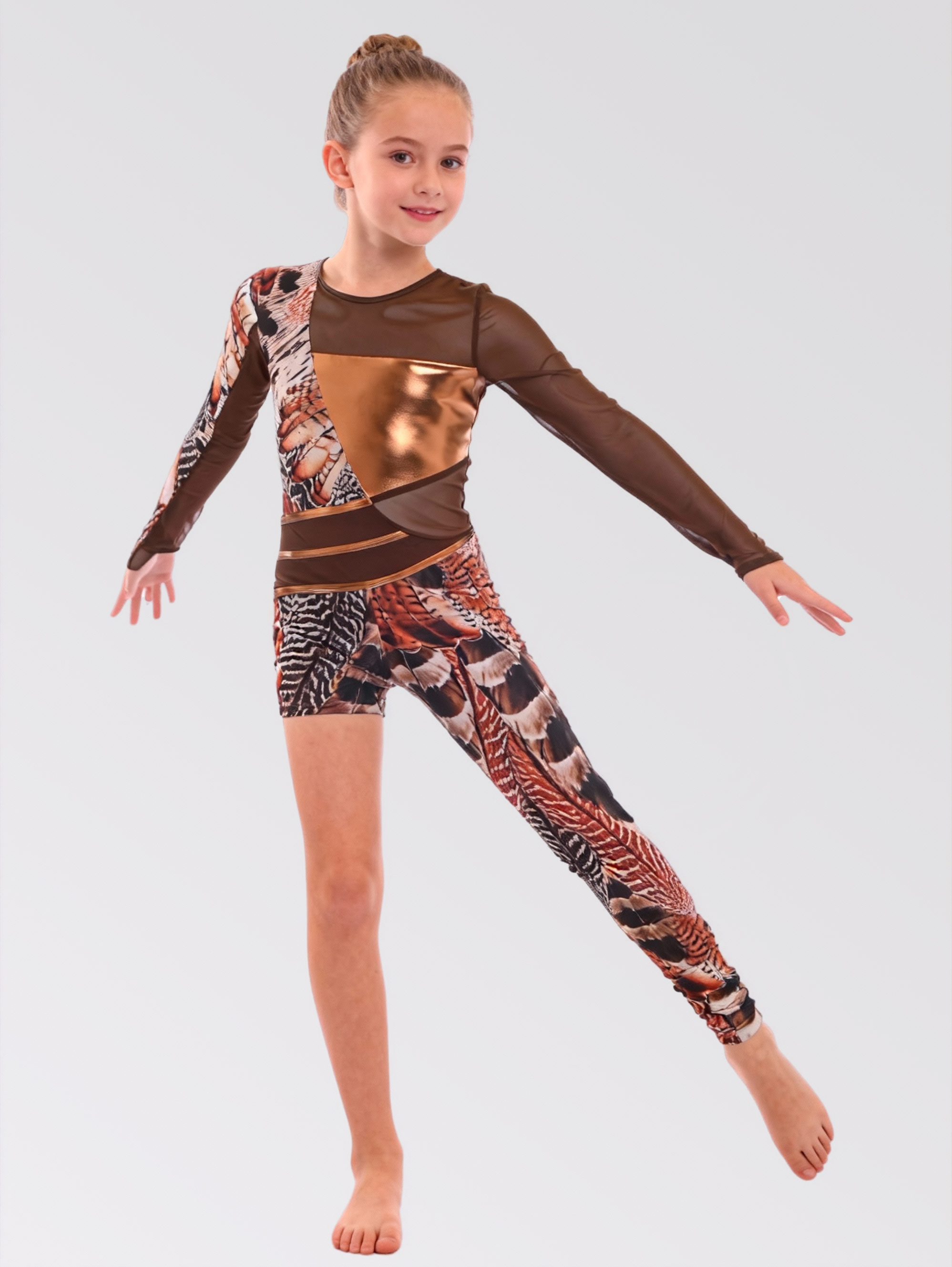
Fabric Elasticity Matters More Than You Think for Children's Performance Wear
A child on stage executes a grand jeté, arms extended, back arched. The costume stretches across the shoulder blades, then snaps back into place as the dancer lands. That moment — when fabric moves in perfect sync with a young performer's body — separates a well-made garment from one that restricts, bunches, or tears mid-routine.
Kids costumes built for dance and performance demand fabrics that deliver four-way stretch, meaning the textile extends and recovers equally in horizontal, vertical, and diagonal directions. Standard cotton or polyester blends with 3% to 5% elastane provide two-way stretch at best — adequate for casual wear but inadequate for the range of motion required in ballet, jazz, tap, or lyrical dance.
Why Spandex Content Determines Costume Performance
The 10% to 20% Rule for Dance-Grade Stretch
Professional kids costumes typically use nylon/spandex or polyester/spandex blends with spandex content between 10% and 20% in key stress zones — shoulders, torso, and hip areas. Below 10%, the fabric lacks the recovery force to return to its original dimensions after repeated stretching. A leotard with 8% spandex might fit perfectly at dress rehearsal but develop sagging at the chest and crotch after three washes.
Above 20% spandex, the fabric becomes overly compressive, which can restrict breathing during sustained aerobic activity. Young dancers performing three-minute routines need unrestricted diaphragmatic movement. The sweet spot of 12% to 16% spandex provides elongation exceeding 200% with recovery rates above 95% after 10,000 stretch cycles — verified through ASTM D4964 tension testing.
Fabric Weight and Breathability for Active Children
Children generate proportionally more body heat than adults during physical activity — a 30 kg child dancing vigorously can produce metabolic heat equivalent to 300 watts per square meter of body surface. Kids costumes that trap this heat lead to overheating, decreased performance, and discomfort. Mesh panels placed under the arms and along the spine — common in well-constructed dance leotards — create ventilation channels that allow convective heat dissipation without compromising structural integrity.
Moisture-wicking finishes applied to polyester-spandex blends draw sweat away from the skin. Unlike cotton, which absorbs up to 7% of its weight in moisture and becomes heavy and cold against the skin, synthetic blends transport moisture to the fabric surface where it evaporates. This keeps young performers dry through dress rehearsals that may run two to three hours.
A Dance Studio's Fabric Trial in Melbourne
A competitive dance studio in Melbourne, Australia, preparing 28 dancers aged 7 to 14 for a regional competition, ordered two batches of kids costumes — one in a standard polyester-cotton blend with 5% elastane, the other in a nylon-spandex blend with 15% spandex content sourced from SHAOXING AIDENG GARMENTS. After eight weeks of twice-weekly rehearsals and four full run-throughs, the low-spandex batch showed visible bagging at the knees and elbow points in 18 of 28 garments. The nylon-spandex batch, by contrast, retained original shape across all 28 garments with zero seam failures and consistent color saturation.
The studio director reported that dancers in the higher-spandex costumes demonstrated measurably better extension in arabesque positions — the fabric simply moved with them instead of pulling against the movement. This difference translated directly to scoring, with the studio's average competition score rising by 1.8 points compared to the previous season.
Selecting the Right Material for Different Performance Types
Ballet costumes benefit from a combination of structured bodices with flexible stretch panels. High-density tulle skirts — up to 12 layers in professional kids costumes — provide volume without weight, while the bodice uses a nylon-spandex blend that supports posture without restricting arm movement above the head. Jazz and tap costumes prioritize freedom in the lower body, favoring polyester-spandex blends in the 15% to 18% spandex range with reinforced gussets that prevent tearing during high kicks and rapid direction changes.
OEKO-TEX® Standard 100 certification provides assurance that the fabric has been tested for harmful substances — particularly important for children's garments where skin contact is sustained and absorption rates are higher than in adults. All fabrics should meet at minimum the EN 71-3 migration limits for heavy metals.
Frequently Asked Questions
What makes a fabric "stretchable" for kids costumes?
A stretchable fabric contains elastane (spandex/Lycra) fibers that can elongate 200% to 500% beyond their resting length and recover to original dimensions. For dance-grade performance, the stretch must be four-way — working equally in all directions — rather than two-way, which only stretches horizontally or vertically. SHAOXING AIDENG GARMENTS uses nylon/spandex and polyester/spandex blends with 10% to 20% spandex content for reliable recovery.
Can stretchable kids costumes survive frequent washing?
Yes, when properly constructed. Nylon/spandex blends retain shape through 50+ wash cycles when washed in cold water and air-dried. Heat from machine drying degrades spandex fibers, reducing recovery capacity by up to 30% within 10 high-heat cycles. Colorfastness to washing should meet ISO 105-C06 standards for costume-grade fabrics.
What is the difference between two-way and four-way stretch?
Two-way stretch extends in one direction only — typically width-wise — and provides limited freedom for dance movements like arabesques or high kicks. Four-way stretch extends and recovers in both horizontal and vertical directions simultaneously. This multidirectional elasticity is essential for costumes that must accommodate full-body extension without binding or riding up.
Are stretchable fabrics safe for children's sensitive skin?
Quality stretchable fabrics certified to OEKO-TEX® Standard 100 have been tested for over 100 harmful substances including formaldehyde, heavy metals, and phthalates. The smooth surface of nylon-spandex blends also reduces friction against skin during repetitive movements, lowering the risk of chafing compared to textured cotton blends.
What fabric blend works best for ballet tutus?
Classical ballet tutus pair a stretch bodice — typically nylon/spandex with 12% to 15% elastane — with a non-stretch skirt constructed from high-density tulle. The bodice provides flexibility for upper-body port de bras, while the stiffened tulle layers (up to 12 for professional pancake tutus) maintain the iconic flat silhouette without requiring stretch.
How can I test stretch quality when sourcing kids costumes?
Request a fabric swatch and perform a manual recovery test: stretch the fabric to twice its length, hold for 10 seconds, then release. Quality dance-grade fabric should recover to within 5% of its original dimension within 3 seconds. Also inspect seam construction — flatlock or coverstitch seams distribute tension better than overlock seams and reduce irritation points against children's skin.